Introduction
Autonomous vehicle development requires extensive testing under thousands of driving conditions before vehicles can safely operate on public roads. While computer simulations and proving grounds remain essential, many critical validation tasks require highly repeatable physical motion testing in a controlled laboratory environment. A 6-axis Stewart platform enables engineers to accurately reproduce vehicle dynamics, road vibrations, cornering, braking, acceleration, and sensor movement in six degrees of freedom, making it an indispensable tool for autonomous vehicle development, sensor validation, and Hardware-in-the-Loop (HIL) testing. This guide explains how a 6-axis Stewart platform supports autonomous vehicle testing and what engineers should consider when selecting the right system.
Quick Answer
A 6-axis Stewart platform improves autonomous vehicle testing by reproducing realistic vehicle motion in six degrees of freedom (surge, sway, heave, roll, pitch, and yaw). It enables repeatable laboratory testing of cameras, LiDAR, radar, IMUs, GPS modules, and autonomous driving algorithms under controlled dynamic conditions, reducing development time while improving testing accuracy and safety.
Why Autonomous Vehicle Testing Requires Motion Simulation
Autonomous vehicles rely on multiple sensors working together to perceive the surrounding environment.
These include:
During real driving, these sensors experience continuous vehicle motion caused by:
Acceleration
Braking
Steering
Road irregularities
Wind
Vehicle vibration
Testing these conditions repeatedly on public roads is expensive, time-consuming, and often difficult to reproduce.
A Stewart platform creates repeatable motion profiles inside a laboratory, allowing engineers to validate both hardware and software under identical conditions.
Industry Insight
Modern autonomous vehicle development increasingly combines digital simulation with physical motion platforms to validate perception systems before expensive on-road testing begins. Controlled laboratory testing significantly improves repeatability compared with real-world driving.
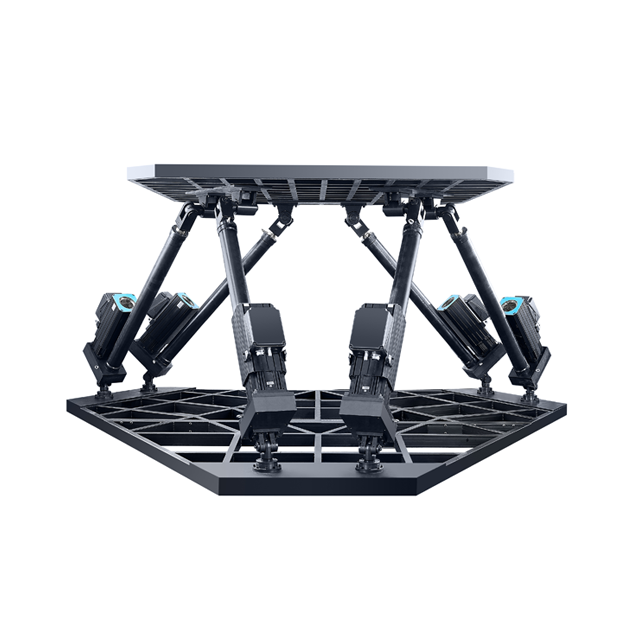
A 6-axis Stewart platform is a parallel robotic mechanism consisting of:
Fixed base
Moving platform
Six synchronized linear actuators
Universal or spherical joints
Real-time motion controller
The coordinated movement of six actuators generates six independent degrees of freedom:
Surge
Sway
Heave
Roll
Pitch
Yaw
Unlike serial robotic systems, the Stewart platform distributes loads across all actuators simultaneously, providing excellent rigidity, positioning accuracy, and dynamic response.
Table 1. Six Degrees of Freedom for Vehicle Simulation
Motion | Vehicle Scenario |
Surge | Acceleration and braking |
Sway | Lane changes and cornering |
Heave | Road bumps and uneven pavement |
Roll | Vehicle body roll during turning |
Pitch | Braking and hill climbing |
Yaw | Steering and directional changes |
Buyer Consideration
Selecting a Stewart platform with balanced performance across all six axes usually delivers more realistic vehicle dynamics than choosing a platform with excessive travel in only one or two directions.
Instead of moving an entire vehicle, engineers typically mount sensors, test rigs, or partial vehicle assemblies on the moving platform.
The platform reproduces motion recorded from real driving conditions or generated by vehicle simulation software.
This enables engineers to evaluate:
Industry Insight
Many autonomous vehicle laboratories use Stewart platforms to reproduce road profiles collected during real-world testing. Engineers can repeat identical motion sequences hundreds of times, making algorithm comparison far more reliable than repeating public road tests.
Table 2. Typical Autonomous Vehicle Testing Applications
Test Type | Stewart Platform Function |
Camera Validation | Simulates vehicle movement |
LiDAR Testing | Reproduces vibration and motion |
Radar Evaluation | Tests sensor stability |
IMU Calibration | Generates controlled motion |
Sensor Fusion | Synchronizes multiple sensor movements |
Localization Testing | Simulates real driving dynamics |
Expert Tip
A Stewart platform should reproduce actual vehicle motion rather than exaggerated movement. High positioning accuracy and low latency are generally more important than maximum travel distance when validating autonomous driving systems.
Key Benefits for Autonomous Vehicle Development
Compared with traditional road testing alone, Stewart platforms provide several important advantages.
Repeatable Test Conditions
Every motion profile can be repeated with extremely high consistency.
This allows direct comparison between:
Sensor versions
Software updates
AI algorithms
Calibration methods
Safer Testing Environment
Potentially hazardous driving situations can be recreated without placing engineers or vehicles at risk.
Examples include:
Emergency braking
Obstacle avoidance
High-speed lane changes
Rough road conditions
Faster Development
Laboratory testing can continue regardless of:
Weather
Traffic
Road availability
Seasonal conditions
Reduced Development Costs
Repeated laboratory testing often reduces:
Vehicle operating costs
Driver expenses
Fuel consumption
Travel time
Prototype wear
Benefit | Engineering Value |
Repeatability | Consistent validation |
Safety | Reduced road testing risk |
Faster Development | Shorter validation cycles |
Lower Cost | Reduced prototype operation |
Controlled Environment | Stable test conditions |
Higher Accuracy | Improved sensor evaluation |
Practical Guidance
The greatest value of a Stewart platform is not replacing road testing entirely but reducing the number of expensive field tests by validating sensors and control algorithms under repeatable laboratory conditions before vehicle deployment.
A professional Stewart platform supports numerous validation activities throughout the autonomous vehicle development cycle.
Camera Stabilization Testing
Engineers evaluate how vehicle motion influences:
Image sharpness
Object detection
Lane recognition
Traffic sign recognition
LiDAR Validation
Controlled motion allows evaluation of:
Point cloud consistency
Motion distortion
Object tracking
Environmental perception
IMU and GPS Calibration
The platform generates precisely controlled motion for calibrating inertial navigation systems and validating localization algorithms.
Hardware-in-the-Loop (HIL) Testing
Vehicle controllers interact with simulated vehicle dynamics while physical sensors experience synchronized six-axis movement.
Table 4. Typical Hardware Tested
Hardware | Test Objective |
Cameras | Image stability |
LiDAR | Point cloud accuracy |
Radar | Target detection |
IMU | Motion measurement |
GPS Modules | Localization validation |
Electronic Control Units | Hardware-in-the-Loop testing |
Industry Insight
As autonomous driving systems become increasingly dependent on multi-sensor fusion, Stewart platforms are evolving from simple motion simulators into integrated validation systems capable of synchronizing physical motion with digital vehicle models and real-time sensor data.
Key Specifications to Consider
Selecting a Stewart platform for autonomous vehicle testing involves more than comparing payload capacity.
Engineers should evaluate several performance parameters.
Payload Capacity
The platform should safely support:
Future upgrades should also be considered during system sizing.
Positioning Accuracy
Autonomous vehicle sensors require extremely precise motion.
High positioning repeatability helps ensure consistent test results across multiple validation cycles.
Motion Bandwidth
The platform should accurately reproduce:
Road vibration
Suspension movement
Steering inputs
Vehicle body dynamics
Higher bandwidth enables more realistic simulation of dynamic driving events.
Low Latency
Real-time synchronization between simulation software, sensors, and motion hardware is essential.
Low latency reduces measurement errors during Hardware-in-the-Loop and sensor fusion testing.
Open Software Architecture
Professional platforms should support integration with engineering software such as:
Table 5. Important Selection Criteria
Specification | Why It Matters |
Payload Capacity | Supports complete test equipment |
Position Accuracy | Improves repeatability |
Motion Bandwidth | Reproduces realistic vehicle dynamics |
Low Latency | Synchronizes sensor measurements |
Software Integration | Simplifies system development |
Continuous Duty Cycle | Supports long testing sessions |
Buyer Consideration
When comparing suppliers, request actual positioning accuracy, repeatability, latency, and motion bandwidth data rather than relying only on maximum travel specifications.
Common Challenges and Solutions
Autonomous vehicle testing introduces unique engineering challenges that require precise motion control.
Table 6. Common Challenges and Recommended Solutions
Challenge | Possible Cause | Recommended Solution |
Sensor data inconsistency | Motion repeatability limitations | Use high-precision servo control |
Camera image blur | Excessive vibration | Optimize motion profiles |
LiDAR point cloud distortion | Motion synchronization errors | Reduce controller latency |
IMU calibration drift | Inaccurate motion reproduction | Improve positioning accuracy |
Hardware integration difficulties | Closed control architecture | Select an open SDK platform |
Long validation cycles | Limited laboratory automation | Integrate automated testing workflows |
Practical Guidance
Accurate motion reproduction is often more valuable than aggressive platform movement. Smooth, repeatable six-axis motion provides more reliable sensor validation and simplifies comparison between different software versions.
Common Misconception: Autonomous Vehicles Can Be Fully Tested in Simulation Software
Some developers believe that computer simulation alone is sufficient for autonomous vehicle validation.
While digital simulation has become an essential development tool, it cannot fully reproduce the physical behavior of real sensors.
Factors such as:
can only be evaluated using physical testing.
A Stewart platform bridges the gap between virtual simulation and on-road testing by reproducing realistic vehicle motion under controlled laboratory conditions.
What Engineers Should Know
The most effective validation strategy combines digital simulation, Hardware-in-the-Loop testing, motion platform testing, and controlled road testing. Each stage identifies different types of system behavior before full-scale deployment.
Case Study
Project Background
An autonomous vehicle technology company was developing a next-generation perception system integrating cameras, LiDAR, radar, and inertial navigation sensors.
The engineering team needed a repeatable laboratory environment to evaluate sensor fusion algorithms before conducting large-scale road testing.
Challenge
Road testing presented several limitations:
Changing weather conditions
Inconsistent traffic environments
Difficulty reproducing identical driving events
High vehicle operating costs
Long validation cycles
These variables made it difficult to compare software updates objectively.
Solution
The company implemented a 6-axis Stewart platform integrated with its Hardware-in-the-Loop testing environment.
The platform reproduced recorded vehicle dynamics, including:
Rapid acceleration
Emergency braking
Sharp cornering
Road surface vibration
Uneven pavement
Lane-change maneuvers
Camera systems, LiDAR sensors, radar modules, and IMUs were mounted directly on the platform while the autonomous driving software processed synchronized sensor data in real time.
Results
Following implementation:
Sensor validation became highly repeatable.
Software comparison required fewer road tests.
Camera stabilization performance improved.
LiDAR point cloud consistency increased.
Hardware-in-the-Loop development cycles were shortened.
Overall validation efficiency improved while reducing testing costs.
Lessons Learned
The project demonstrated that combining physical six-axis motion simulation with digital vehicle models creates a more comprehensive validation process than relying solely on computer simulation or public road testing. Repeatable laboratory testing enabled engineers to identify sensor integration issues earlier in the development cycle.
Buyer Checklist
Before purchasing a 6-axis Stewart platform for autonomous vehicle testing, verify the following:
What payload capacity is required?
What positioning accuracy and repeatability are specified?
Does the platform provide low-latency motion control?
Can it reproduce realistic vehicle dynamics?
Is the software compatible with existing simulation tools?
Does it support Hardware-in-the-Loop integration?
Is continuous operation supported?
Are safety functions built into the control system?
Does the supplier provide engineering and commissioning support?
Can the system be expanded for future research projects?
Expert Recommendations
Experienced autonomous vehicle engineers generally recommend:
Define sensor validation objectives before selecting a platform.
Prioritize positioning accuracy and repeatability over maximum motion travel.
Select electric servo-driven Stewart platforms for precise sensor testing.
Choose systems with open APIs and SDKs for easier software integration.
Verify latency and motion bandwidth during supplier evaluation.
Partner with manufacturers offering customization, integration support, and long-term technical service.
Conclusion
A 6-axis Stewart platform has become an important tool in autonomous vehicle development by providing highly accurate, repeatable motion simulation for sensor validation, Hardware-in-the-Loop testing, and autonomous driving research. Its ability to reproduce real-world vehicle dynamics under controlled laboratory conditions enables engineers to evaluate cameras, LiDAR, radar, IMUs, and sensor fusion algorithms with greater consistency than conventional road testing alone.
By carefully considering payload capacity, motion accuracy, software compatibility, latency, and long-term system scalability, organizations can select a Stewart platform that accelerates development, improves testing efficiency, and reduces overall validation costs. As autonomous driving technology continues to evolve, six-axis motion platforms will remain a key component of comprehensive vehicle testing and verification.
FAQ
A Stewart platform reproduces realistic six-degree-of-freedom vehicle motion in a controlled laboratory environment. It allows engineers to evaluate sensors, perception systems, and autonomous driving algorithms repeatedly under identical conditions.
Commonly tested devices include cameras, LiDAR, radar, IMUs, GPS receivers, ultrasonic sensors, and complete sensor fusion systems used in autonomous vehicles.
No. A Stewart platform complements road testing by providing repeatable laboratory validation before vehicles enter real-world testing. This reduces development costs while improving testing efficiency.
Why is low latency important?
Low latency ensures that physical platform movement remains synchronized with simulation software and sensor measurements. This is essential for accurate Hardware-in-the-Loop testing and reliable perception system validation.
Key considerations include payload capacity, positioning accuracy, motion bandwidth, software integration, open APIs, continuous duty capability, safety systems, technical support, and the ability to support future testing requirements.