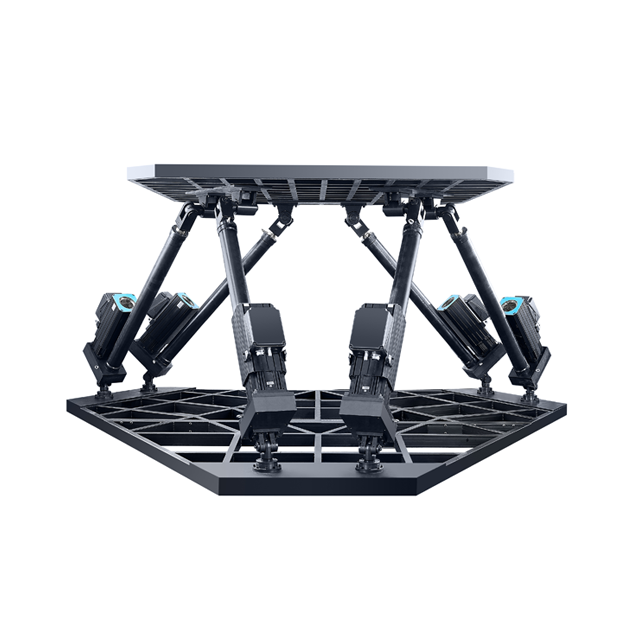
The shift toward electrified mobility is forcing test engineers to rethink how we validate vehicle chassis systems. With heavier battery packs, novel suspension architectures and more demanding NVH (Noise, Vibration & Harshness) criteria, the traditional test rigs fall short. That’s why the 6 DOF Motion Platform (also known as a 6-Axis Motion Platform or Six Degree of Freedom System) with ~5000 kg payload capacity is becoming a game-changer in EV chassis testing. This article explores how such a platform elevates the realism, repeatability and efficiency of EV chassis validation.
What is a 6DOF Motion Platform?
In simple terms, a 6 DOF motion platform provides controlled movement in six axes:
Surge (forward/back)
Sway (left/right)
Heave (up/down)
Roll (rotation about X-axis)
Pitch (rotation about Y-axis)
Yaw (rotation about Z-axis)
| Axis | Motion Type | Typical Vehicle Event |
| Surge | Translational X | Hard braking or acceleration |
| Sway | Translational Y | Lane change, side wind |
| Heave | Translational Z | Road bump, pothole |
| Roll | Rotation about X | Body lean in cornering |
| Pitch | Rotation about Y | ‘Nose-down’ under braking or rise under acceleration |
| Yaw | Rotation about Z | Turning, skid response |
Tip: Use of a full six-axis rig means you’re not just simulating individual events (e.g., vertical bump) but combined motions (e.g., lateral bump while turning) — a key benefit when testing EV chassis under real-world stresses.
Why EV Chassis Testing Demands Multi-Axis Solutions?
EV chassis systems bring unique test requirements:
Large under-floor battery packs shift mass and alter center-of-gravity dynamics.
Instant torque delivery creates sharp load changes across suspension and chassis.
Lower noise floor (lack of engine noise) means NVH issues become more perceptible.
Structural fatigue and thermal expansion become more critical in lightweighting efforts.
Traditional single- or three-axis test rigs cannot replicate the complex multi-directional forces that an EV chassis sees during cornering + braking + road impact combinations. A 6 DOF system allows engineers to:
Replicate realistic road profiles (with heave + sway + roll)
Combine braking/acceleration loads (surge) with cornering dynamics (roll + yaw)
Evaluate the structural response of battery support frames, chassis rails, suspension mounts and more in a unified test environment.
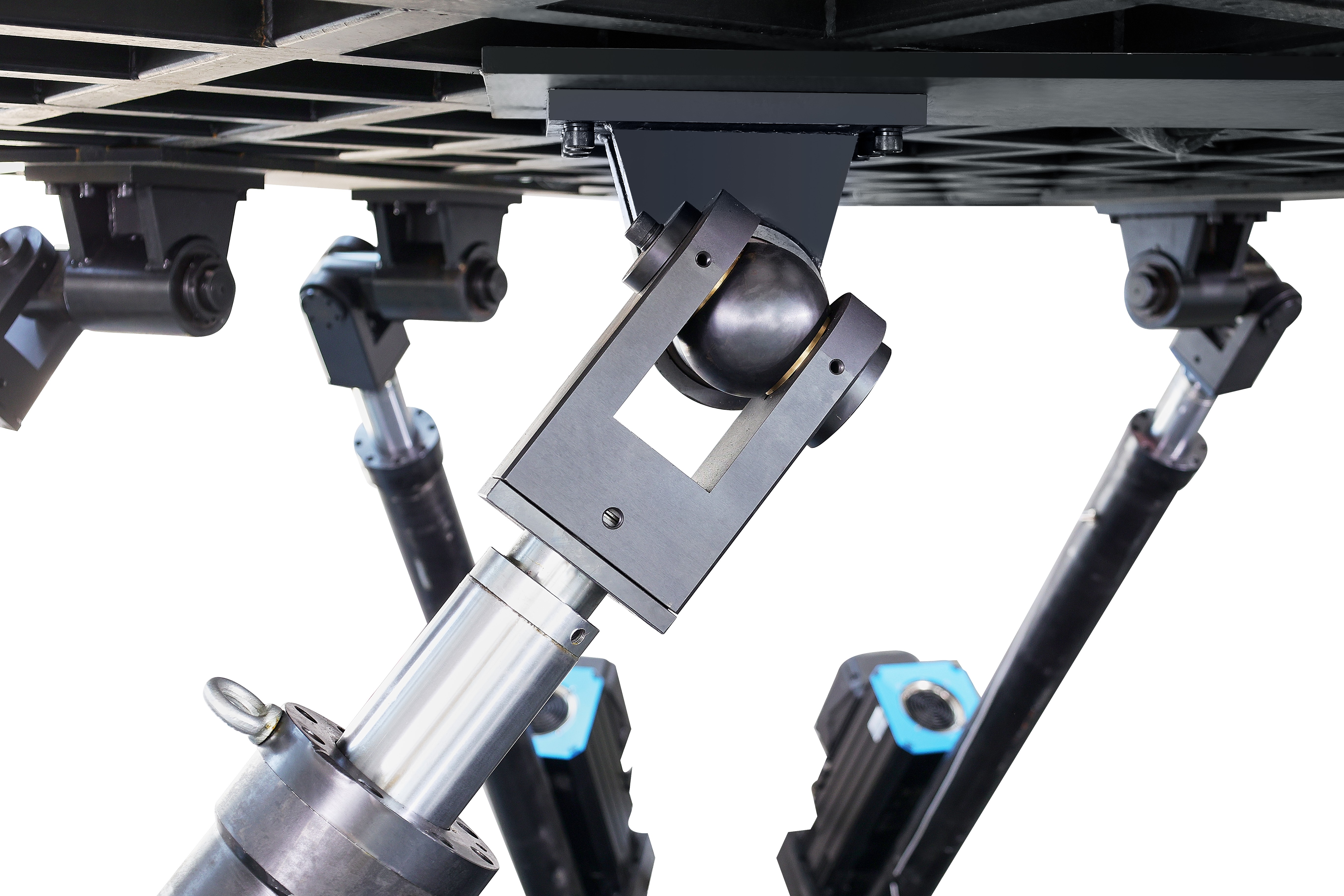
Key Specifications of a 5000 kg Payload 6DOF Platform
Using a typical offering as an example (see FDRAutoIndustry’s 5000 kg 6DOF Platform), the spec sheet might include:
Payload capacity: up to ~5000 kg (supports full EV chassis or large subsystem)
Platform top size: ~1500 × 1500 mm (ample for a rolling chassis)
Heave stroke: up to ~0-450 mm
Surge/Sway stroke: ±225 mm
Roll/Pitch/Yaw: ±25° (or similar)
Repeatability: ±0.1 mm translational / ±0.5° rotational
Long-term drift: ≤ 0.00025 m after 12 h continuous operation
Such specifications mean you can mount a complete EV chassis (battery + frame + suspension) and subject it to realistic multi-axis dynamic loading with high fidelity.
Application Scenarios in EV Chassis Testing
Here are detailed applications where a 5000 kg payload 6DOF platform brings major value:
1. Full-Chassis Vibration & Shock Testing
Mount the full EV chassis and run sequences replicating road impacts, curbs, potholes, and longitudinal shocks. The heave + surge + pitch motion sequences reveal potential fatigue cracks, weld issues, or battery enclosure stresses.
2. Combined Cornering/Braking Dynamic Tests
Simultaneously apply lateral (sway), longitudinal (surge) and rotational (roll, yaw) motions to simulate scenarios like “hard braking while cornering on a bumpy surface”. This reveals how the chassis, suspension mount points and battery pack respond under complex multi-axis loading.
3. NVH & Ride Comfort Evaluation
Because EVs lack engine masking noise, chassis and battery pack induced vibrations become more noticeable. Using the platform’s precise motion control, you can inject controlled excitations (e.g., pitch-heave perturbations) and measure responses (accelerometers, strain gauges) to optimize damping and isolation solutions.
4. Durability & Fatigue Life Acceleration
Use the motion platform to perform thousands or millions of load cycles in compressed time. For example, simulate many years of driving – potholes, speed-bumps, lane-changes and hard stops – ensuring battery tray mounts, chassis rails and suspension brackets survive the full lifecycle.
5. Prototype & Variant Validation Efficiency
With the same rig, you can test multiple chassis versions (different battery packs, suspension configurations, material changes) under identical motion profiles. This makes comparisons fair, repeatable, and faster, supporting iterative design and validation.
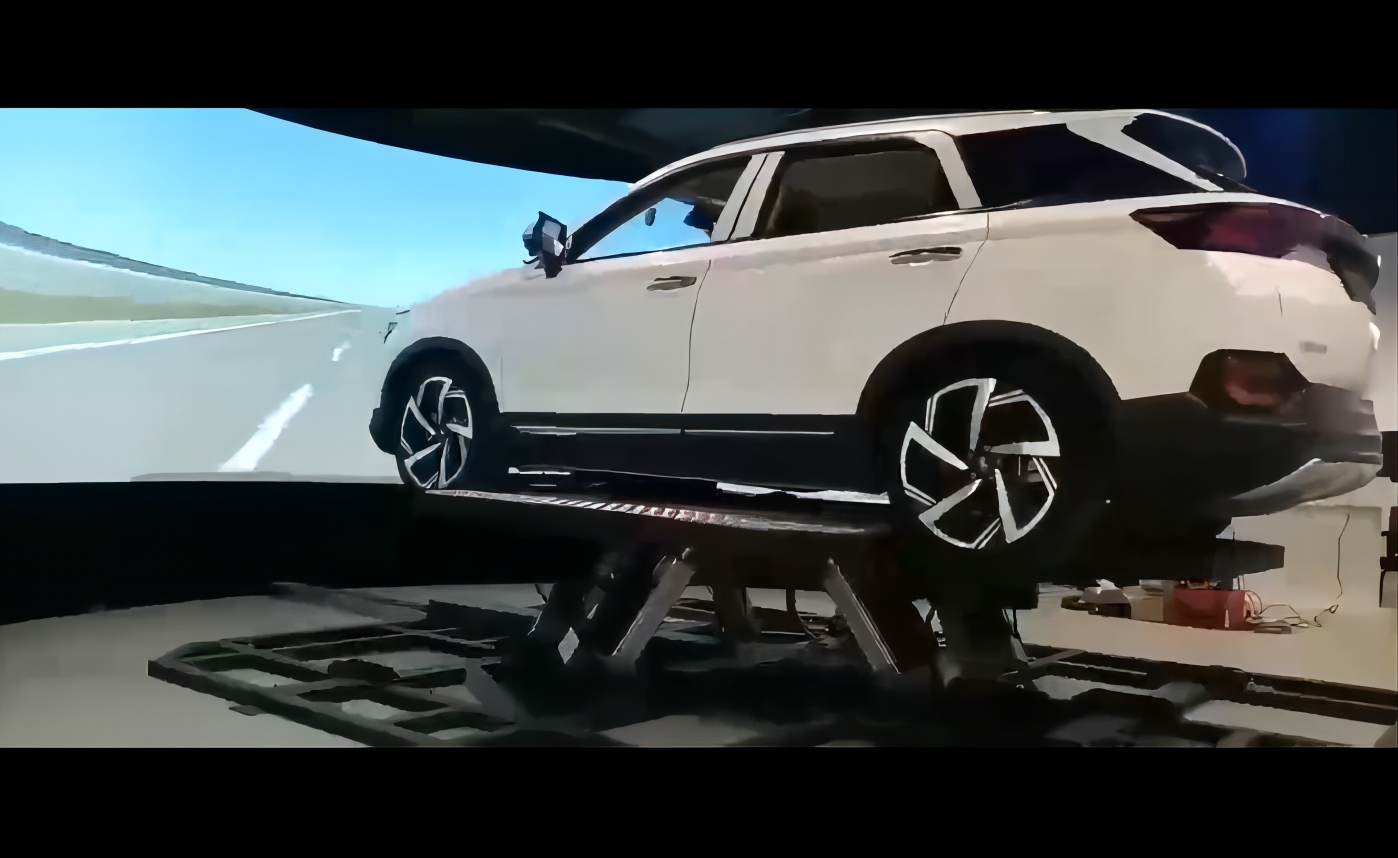
Integration & Operational Best Practices
For effective deployment of such a high-capacity 6DOF platform, engineers should keep in mind:
Mounting Considerations: Design fixtures for the EV chassis ensuring accurate center-of-gravity alignment, secure battery pack mounting, and proper harness routing.
Motion Profile Development: Use real-world road data (accelerometer logs, 3-axis IMU data) and convert into 6DOF motion commands. You might reference [real-time simulation integration guides] via internal links.
Data Acquisition Synchronization: Combine the platform motion controller with your DAQ system (accelerometers, strain gauges, NVH sensors) and ensure timestamping, closed-loop verification and cross-axis correlation.
Safety & Calibration: Heavy payloads mean significant forces. Implement mechanical stops, emergency stop systems, and regular calibration of actuators and sensors.
Test Workflow Efficiency: Leverage the platform’s repeatability to run back-to-back tests, compare variants, generate large datasets, and feed results back into simulation loops or digital twin frameworks.
Advantages Summary
Here’s a quick summary of key advantages when using a ~5000 kg-class 6DOF platform for EV chassis testing:
Realistic multi-axis load replication (translation + rotation)
Ability to test full chassis assemblies, including battery packs
High repeatability and precision for consistent benchmarking
Reduced reliance on expensive and time-consuming road testing
Faster design iteration and validation cycles
Frequently Asked Questions (FAQ)
Can a 6DOF Motion Platform test a full EV chassis?
Yes. A 5000 kg-payload 6-Axis Motion Platform supports testing of complete EV chassis assemblies — including the battery pack, suspension, and underbody structure. This eliminates the need to use partial or simplified mock-ups, allowing engineers to evaluate the real mechanical behavior of the full vehicle.
How does a 6-Axis Motion Platform simulate real-world road conditions?
By combining six degrees of freedom — surge, sway, heave, roll, pitch, and yaw — the system reproduces complex scenarios such as braking while cornering over uneven terrain or battery-pack shock loads during pothole impact.
Compared with traditional single-axis rigs, it delivers a far more realistic representation of multi-directional vehicle motion.
How accurate and repeatable are the results?
Modern 6DOF platforms use servo-controlled actuators and closed-loop feedback systems with accuracy up to ±0.1 mm and ±0.5°. Long-term drift is typically less than 0.00025 m after 12 hours of continuous operation.
This ensures that every test run is consistent — ideal for NVH benchmarking, durability correlation, and regression testing between prototypes.
Can a 6DOF system replace road testing?
Not entirely, but it can reduce physical test mileage by 40 – 60 %. Multi-axis simulation allows early detection of durability or NVH issues, saving time, cost, and prototype wear. Many OEMs now use lab-based motion platforms for pre-validation before final on-road confirmation.
What infrastructure is required for installation?
A 5000 kg-payload rig needs:
Reinforced floor or pit foundation
Three-phase industrial power supply
Controlled environment (temperature & vibration isolation)
Safety enclosure and E-stop system
Integration with DAQ, simulation, and control PCs
Proper planning ensures maximum uptime and operator safety.
How does it integrate with existing test systems?
The motion platform communicates with DAQ and control systems via EtherCAT or CAN-based interfaces. Engineers can import real road-load data, simulation outputs, or user-defined motion sequences.
Some setups also integrate with digital twin environments for closed-loop simulation — linking physical and virtual validation.
What is the ROI of investing in a 5000 kg 6DOF Motion Platform?
Although initial cost and footprint are significant, the benefits include:
Fewer physical prototypes
Shorter development cycles
Reduced on-road testing
Higher product reliability and consistency
Faster time-to-market for new EV models
For large-scale EV programs, the return on investment is typically achieved within 18–24 months.
How future-proof is this technology?
A 5000 kg system offers scalability for upcoming EV architectures — higher battery densities, new chassis materials, and autonomous driving dynamics.
Combined with AI-based motion control and digital-twin integration, next-generation platforms will deliver even more precise, automated, and data-driven testing.
Conclusion
Deploying a ~5000 kg payload 6 DOF motion platform is more than an upgrade—it’s a strategic investment for EV manufacturers and test labs. By enabling full-chassis testing under realistic multi-axis dynamics, you gain deeper structural insights, faster validation cycles and improved NVH/durability outcomes. As EV design continues to evolve, embracing this level of motion simulation becomes a key differentiator in chassis performance and reliability.


