Introduction
Six Degrees of Freedom (6DoF) allows motion in all directions. It provides full spatial freedom, unlike traditional motion platforms.
In this article, we explore how 6DoF enhances simulations and training. You will learn its applications in industries like aerospace, robotics, and VR.
FDR offers precision 6DoF motion platforms for immersive training. Learn more about our products.
How Six Degree of Freedom Systems Work
The mechanics of 6DoF systems rely on a combination of mechanical structures, actuators, and advanced control algorithms. These systems are designed to ensure smooth and accurate movement along all six axes — three translational (surge, sway, heave) and three rotational (pitch, roll, yaw).
Mechanical Architecture and Control Systems
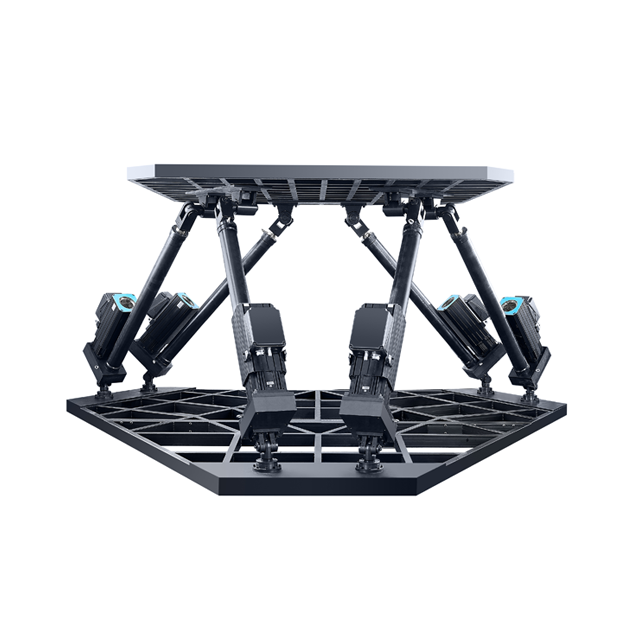
At the heart of 6DoF systems are their mechanical architectures, which often include multi-axis joints, gimbals, or custom motion platforms. These allow movement in all six degrees of freedom. A servo-driven system with real-time feedback helps maintain precision during movement, providing dynamic control and accurate simulation. In applications like flight training or racing simulations, this capability allows trainees to feel every motion, from sharp turns to turbulent maneuvers.
For example, high-load motion platforms support training for demanding applications, such as flight simulators or racing simulators, where precise movement control is essential. With a 6DoF motion platform, users experience motion across all axes—surge, sway, heave, roll, pitch, and yaw—enabling them to simulate real-world forces and scenarios.
Kinematics and Real-Time Feedback
Understanding the system's kinematics (the study of motion) is critical for achieving precise and smooth movement. Forward kinematics (FK) helps determine the position of an object based on given joint angles, while inverse kinematics (IK) calculates the angles needed to reach a specific target. Together, these kinematics systems allow for collision-free motion and optimal performance in complex systems, like robotic arms or training simulators.
Applications of Six Degree of Freedom Systems Beyond Motion Platforms
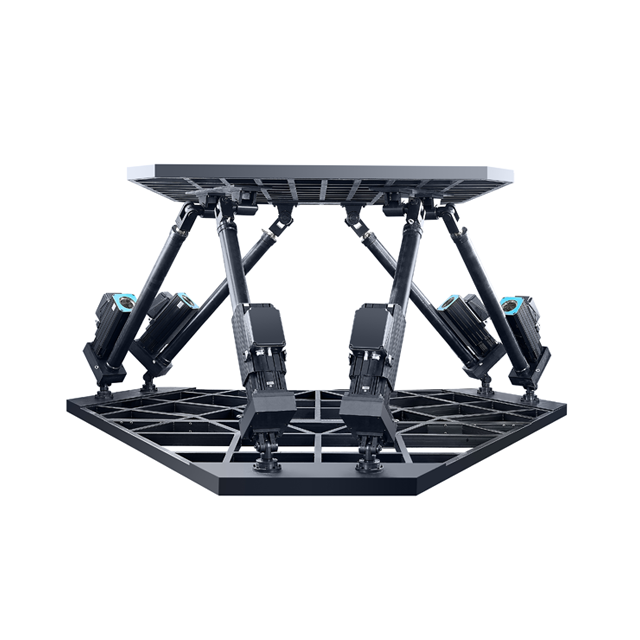
6DoF technology finds applications across numerous industries, from entertainment and education to robotics and industrial manufacturing. Its ability to simulate complex physical environments with accuracy and realism has proven invaluable in both professional and recreational settings.
Robotics and Industrial Automation
In robotic systems, 6DoF is key to enabling precise manipulation and motion. Whether it's a robotic arm performing delicate assembly tasks or a system used for industrial inspections, 6DoF platforms allow the robot to move with the utmost precision and in a fully controlled environment. With the right motion control system, robotic arms can adjust their positions and orientations, making them suitable for automated manufacturing, medical surgeries, and research applications.
A 6DoF motion platform can replicate the dynamics required for advanced robotic systems, ensuring high reliability and repeatability. For instance, an industrial automation system powered by 6DoF can significantly enhance productivity by allowing machines to interact with their surroundings in a much more dynamic and intuitive manner.
Virtual and Augmented Reality (VR/AR)
The immersive experience in VR and AR is taken to the next level with 6DoF technology. For VR games or simulations, the ability to move freely in 3D space is crucial for creating a truly engaging experience. Players can crouch, walk, or tilt their head, and the system will accurately track their movements, replicating how they would behave in the physical world.
In augmented reality, 6DoF is just as impactful, ensuring that virtual objects appear seamlessly integrated into the real world. For example, VR motion platforms with 6DoF capabilities create an authentic, interactive experience where users can move and interact with the digital world in ways that feel natural and intuitive.
Flight Simulators and Vehicle Dynamics
Flight simulators, commonly used for pilot training, rely heavily on 6DoF to recreate real-world conditions. A 6DoF motion platform can replicate complex flight dynamics, including the subtle sensations of turbulence or the abrupt forces felt during rapid acceleration or turns. This allows pilots-in-training to experience and react to situations that would otherwise be too dangerous or costly to replicate in real life.
Similarly, 6DoF systems are employed in vehicle dynamics simulations, whether for automotive racing or vehicle safety training. These simulations can help engineers and drivers test vehicles under extreme conditions, such as high-speed cornering or sudden braking, to understand how the vehicle will behave in different scenarios.
Industry | Application | Key Benefits of 6DoF |
Flight Simulators | Pilot Training, Flight Dynamics | Realistic Turbulence, Immersive Training |
Automotive Industry | Vehicle Dynamics, Racing Simulators | Accurate Vehicle Handling, High-Speed Testing |
Aerospace | Spacecraft Navigation & Training | Simulate Microgravity, Docking Maneuvers |
Virtual Reality (VR) | Immersive VR Experiences | Full Spatial Interaction, Enhanced Immersion |
Comparison: 6DoF vs. 3DoF – Which is Right for Your Needs?
When choosing between a 3DoF or 6DoF system, it’s important to consider the application and performance needs. Both technologies offer rotational and translational movement, but the difference lies in the range of motion and the realism they offer.
3DoF Systems
Typically, 3DoF systems provide rotational movements (pitch, roll, yaw) and a limited translational movement (often heave). These systems are suitable for simpler applications that don’t require full spatial movement, such as basic training or rudimentary simulations. A 3DoF system can mimic the feel of a bumpy ride or simulate rotational motions like the tilt of a car, but it doesn’t offer the complete spatial flexibility of a 6DoF system.
6DoF Systems
6DoF systems, in contrast, allow for full spatial freedom, combining three rotational movements with three translational movements. This makes them ideal for applications that require high levels of immersion, such as advanced flight simulators, complex robotic manipulations, and high-performance gaming. While 6DoF systems come at a higher cost and are more complex to operate, they provide a much richer experience in environments where full movement simulation is necessary.
Feature | 3DoF System | 6DoF System |
Degrees of Freedom | 3 (Pitch, Roll, Yaw) | 6 (Surge, Sway, Heave, Pitch, Roll, Yaw) |
Application | Basic Simulations | Advanced VR, Robotics, Flight Simulators |
Control System | Simple Motion Control | Servo-Driven with Real-Time Feedback |
Load Capacity | Lower (typically up to 2000kg) | Higher (up to 5000kg or more) |
Real-Time Feedback | Limited | Full Motion Tracking with Real-Time Data |
The Future of Six Degree of Freedom Technology
The ongoing evolution of 6DoF technology is expected to introduce even more innovations, particularly as industries like space exploration, autonomous vehicles, and extended reality (XR) continue to grow.
Advancements in Sensors and Control Systems
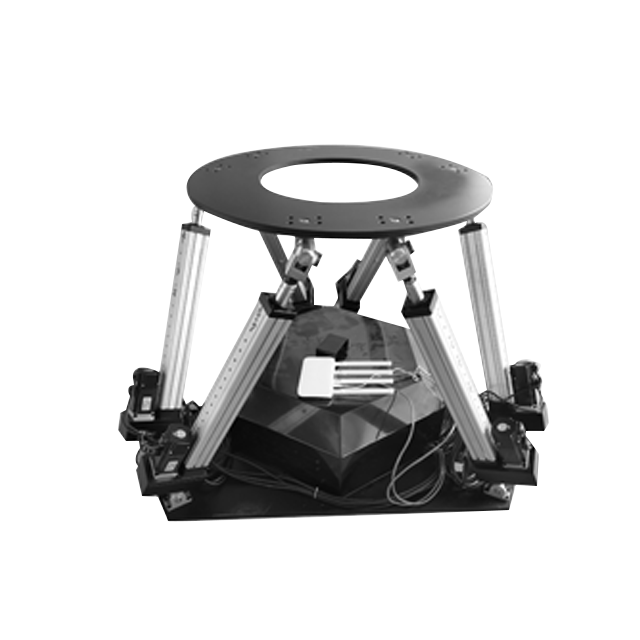
Future 6DoF systems will likely see improvements in sensor technologies, allowing for more accurate tracking and more responsive movements. Real-time feedback systems will become even more precise, ensuring that the system responds seamlessly to user input, no matter the application.
Consumer Electronics and XR
As extended reality (XR) technologies gain traction, 6DoF systems will play a critical role in enhancing virtual and augmented environments. We will likely see 6DoF motion technology integrated into everyday consumer devices, from VR headsets to smartphones. This will create new opportunities for interactive entertainment, gaming, and education.
Space Exploration and Autonomous Vehicles
In the context of space exploration, 6DoF will be crucial for navigating spacecraft and handling delicate tasks in microgravity. Likewise, autonomous vehicles, whether on land, sea, or in the air, will depend on 6DoF systems for precise navigation and obstacle avoidance.
Engineering Challenges and Considerations for 6DoF Systems
While 6DoF systems offer immense benefits, there are engineering challenges that must be addressed to ensure these systems perform optimally.
Structural Integrity and Precision
Achieving the necessary structural integrity while maintaining the ability to move freely in all directions is a challenge. The platform must remain stable while being able to replicate precise motions. This requires high-strength materials and a robust design to handle heavy loads without compromising performance.
Cost and Complexity
Another significant challenge is the cost and complexity of 6DoF systems. These systems require sophisticated servo-controlled motion, real-time feedback, and advanced sensors, which can drive up both costs and the complexity of integration. However, the benefits they provide, such as enhanced realism and precision, make them a valuable investment for industries that demand the highest level of performance.
Engineering Challenge | Description | Considerations for Overcoming Challenge |
Structural Integrity | Maintaining stability while enabling free movement | Use of high-strength materials, advanced frame design |
Precision Control | Ensuring accurate motion without errors | Advanced servo control, real-time feedback systems |
Cost and Complexity | High initial cost and complex system integration | Evaluate ROI, scale solutions for specific needs |
Sensor Calibration | Ensuring sensors provide accurate, collision-free feedback | Use of precision sensors and calibration protocols |
Conclusion
Six Degree of Freedom (6DoF) technology is essential across various industries. It enables precise movement and interaction in robotic arms, flight simulators, VR/AR environments, and vehicle dynamics tests. Despite the high cost and complexity, 6DoF systems provide unmatched realism, flexibility, and immersion. These benefits make 6DoF invaluable for improving training, simulations, and user experience. As technology evolves, 6DoF will open new possibilities in both professional and consumer markets.
FDR offers advanced 6DoF motion platforms designed for precision and immersion. Their solutions deliver exceptional value for training and simulation needs.
Tip:
When selecting a 6DoF system, ensure that its specifications, such as load capacity and motion control, align with the specific demands of your application.
FAQ
Q: What is Six Degree of Freedom (6DoF) technology?
A: 6DoF refers to the ability of an object or system to move in six ways: surge, sway, heave, pitch, roll, and yaw. It enables full spatial freedom, offering a more immersive experience in applications like VR, robotics, and flight simulators.
Q: How does a 6DoF motion platform work?
A: A 6DoF motion platform uses advanced servo-driven systems to replicate real-world movement. It adjusts motion along six axes, providing precise control for simulations and training, especially in industries like aerospace and robotics.
Q: Why is 6DoF important for VR and gaming?
A: 6DoF technology allows users to interact fully with virtual environments, offering more immersive and realistic experiences. It tracks movements in all directions, improving interactivity in VR gaming and training simulations.
Q: What are the benefits of using 6DoF in flight simulators?
A: 6DoF flight simulators provide realistic flight dynamics, simulating turbulence, rapid turns, and altitude changes. This enhances pilot training by offering precise, dynamic control over movement, increasing


