

Views: 0 Author: Site Editor Publish Time: 2026-10-16 Origin: Site


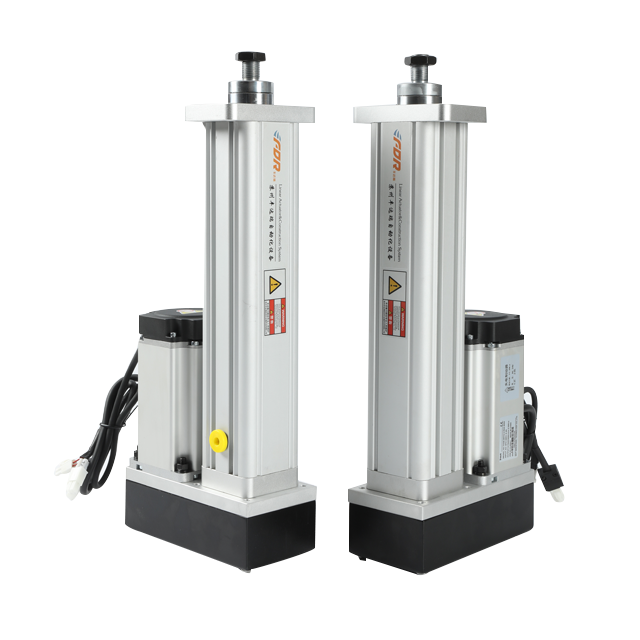
When configuring 3DOF or 6DOF motion platforms, most buyers only focus on stroke, speed, and payload. However, one critical factor that directly determines the platform’s stability, installation height, and dynamic performance is often ignored:
The motor installation structure — Inline or Foldback (Parallel) servo electric cylinder.
Although both types adopt ball screw transmission and closed-loop servo control, their mechanical layout leads to huge differences in overall dimension, center of gravity, high-speed stability, and assembly compatibility.
Many platform jitter problems, limit interference issues, and over-height installation failures are simply caused by incorrect cylinder structure selection.
In this article, we systematically compare inline servo cylinders and foldback servo cylinders, explaining their pros, cons, and best-fit application scenarios for automated equipment and multi-degree-of-freedom motion platforms.
The servo motor is installed in a straight line with the screw. The motor, reducer, and cylinder tube are coaxial.
Power transmission is direct and straight
No steering gear or synchronous belt conversion
Pure mechanical rigid transmission
The motor is mounted parallel to the cylinder body, connected via a high-precision synchronous belt or gear set.
Motor is placed on the side of the cylinder
Greatly shortens the overall installation length
Belt-driven power transfer structure

We tested both structures under the same load (50kg) and speed (500mm/s), recording stability and mechanical loss data.
High rigidity & zero transmission clearance
Stable high-speed operation, no vibration resonance
Best repeated positioning accuracy: ±0.01mm
Longer mechanical service life
Disadvantage: longer total installation length
Ultra-short overall length, saves vertical installation space
Flexible for narrow-space platform design
Slightly higher high-frequency operating noise
Belt pre-tension needs periodic inspection for long-term operation

✅ Direct coaxial transmission, maximum structural rigidity
✅ No intermediate transmission gap, ultra-smooth motion
✅ Perfect for high-frequency dynamic simulation
✅ Lower long-term failure rate
✅ Ideal for precision test platforms and high-fidelity simulators
❌ Longer total body length, requires larger vertical installation space
✅ Extremely compact structure, greatly reduces platform overall height
✅ Lightweight layout, suitable for low-profile equipment design
✅ Same effective stroke with shorter overall size
❌ Belt transmission brings tiny elastic loss under extreme high speed
❌ Requires regular tension maintenance after long running hours
6DOF high-fidelity motion simulation platforms
Seismic simulation & vehicle road reproduction tests
Long-cycle fatigue testing equipment
Projects requiring ultra-stable high-speed dynamic response
Precision industrial positioning and pressing systems
Compact 3DOF agricultural simulation platforms (tea tree pruning testing)
Low-height laboratory test benches
Automated equipment with strict space limitation
Mobile and portable simulation devices
As a professional manufacturer of servo electric cylinders and multi-DOF motion platforms, we adopt targeted structural matching for different projects:
For high-precision, high-dynamic simulation projects, we fully configure inline cylinders to ensure rigid transmission and zero jitter.
For space-limited, compact agricultural and industrial test platforms, we select foldback cylinders to optimize overall size while guaranteeing standard dynamic performance.
This customized matching method avoids performance waste and structural interference, ensuring each motion platform achieves the best cost-performance balance.
Inline and foldback servo electric cylinders are not simply “different shapes”. Their internal transmission structures fundamentally affect the rigidity, stability, lifespan, and installation compatibility of the entire motion platform.
Inline structures pursue ultimate stability and precision; foldback structures pursue compactness and space optimization.
Selecting the correct cylinder structure is as important as choosing stroke and speed.
If you are designing a 3DOF or 6DOF motion platform and need professional structural configuration suggestions, contact our engineering team for free project evaluation.


